Shopping Cart

Angelus Unveils Flying Tourbillon Skeleton Titanium in Vivid Orange

NOVEMBER 17 2025    |    Novelties

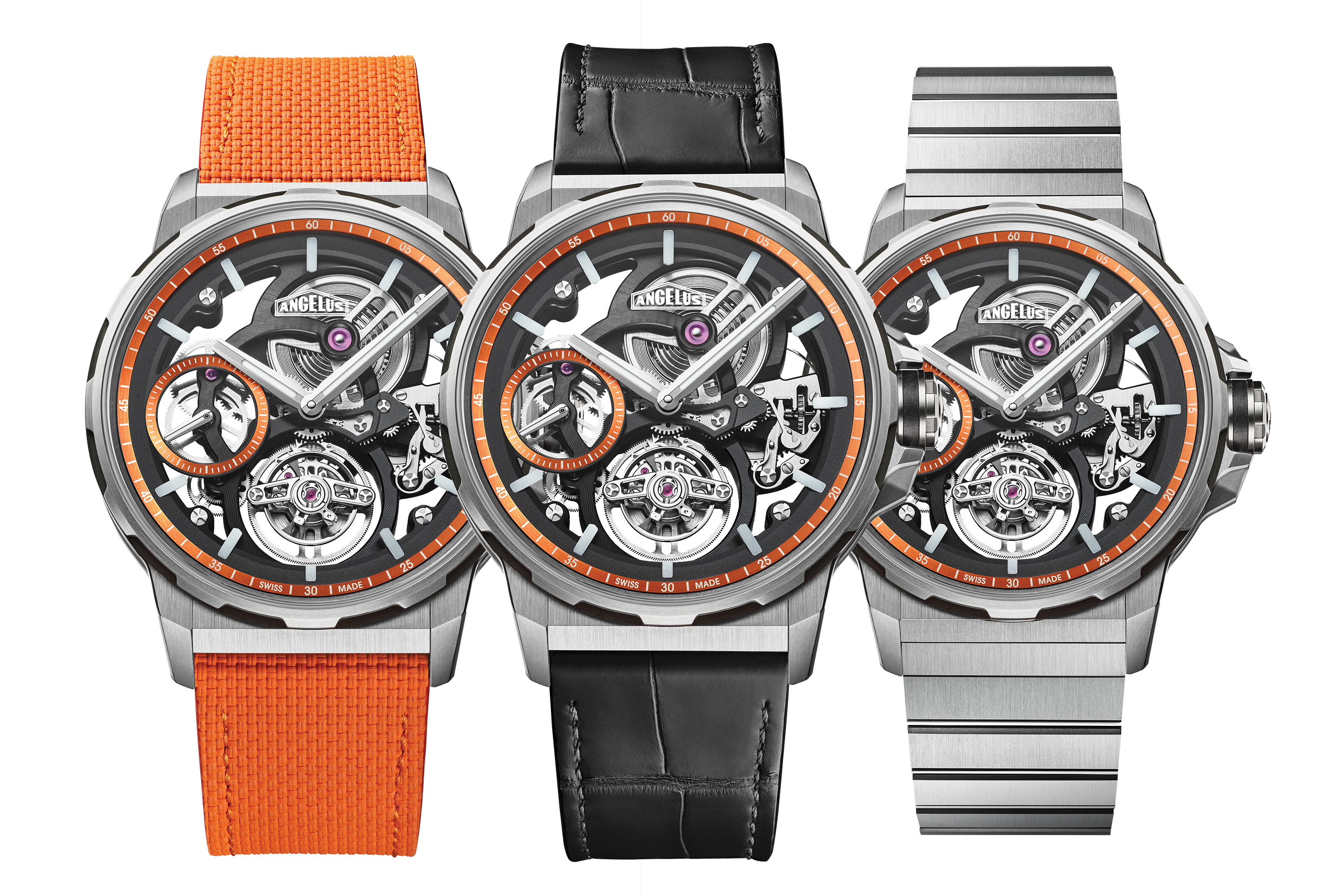
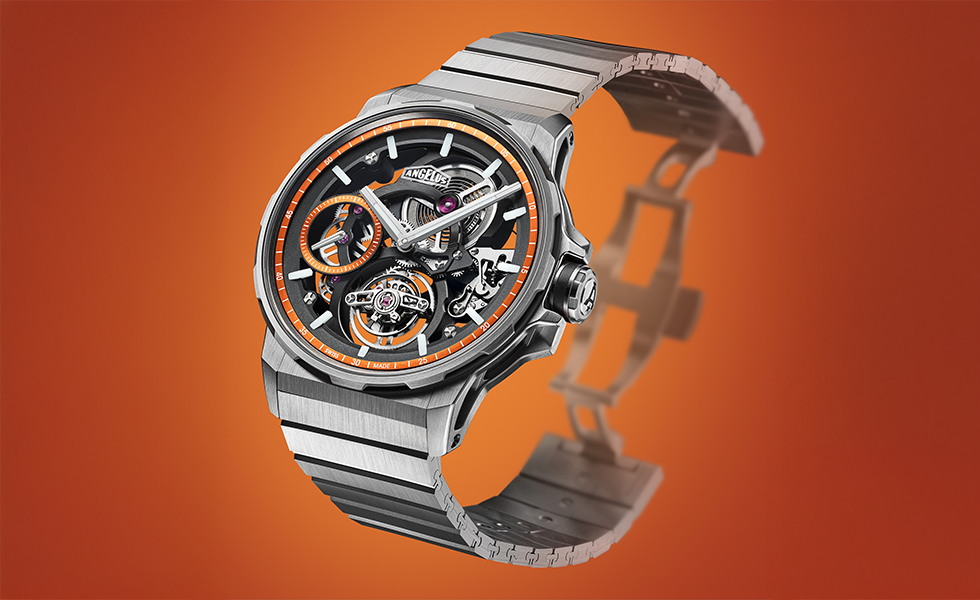
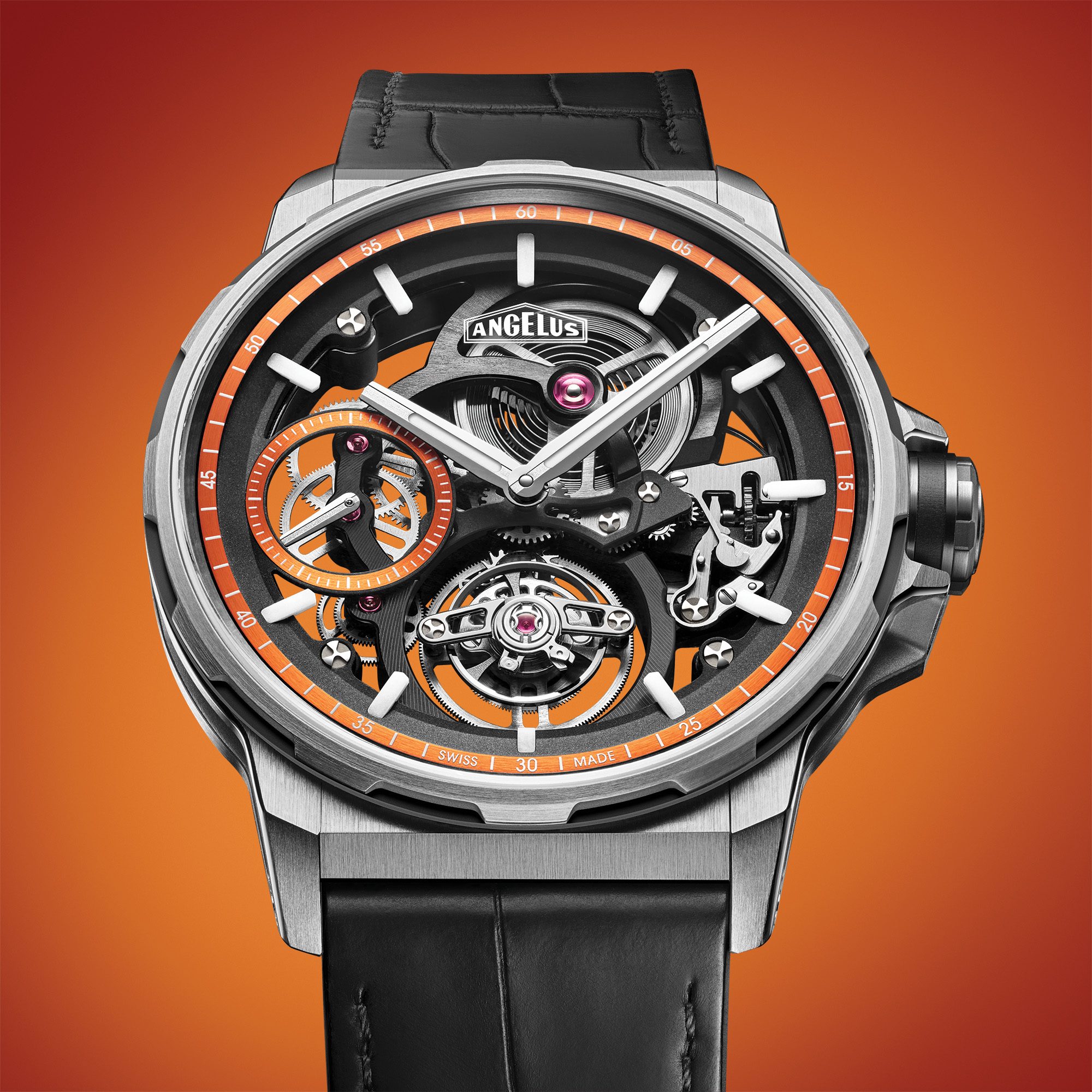
Angelus unveils the Flying Tourbillon Skeleton Titanium, Orange Edition, a vivid expression of horological energy and design. Limited to just 25 pieces, this timepiece transforms skeletonised mechanics into a canvas of colour and contrast. The satin-finished titanium case frames a deep black movement, animated by bright orange accents that highlight the time display and extend to three interchangeable straps. The openwork calibre, designed as a series of interlocking circles, adds architectural depth and visual dynamism.

Every detail of this 42.5 mm watch reflects a unique energy. Chromatic energy flows through the orange highlights. Customisable energy is offered by the quick-release strap system, allowing seamless transitions between black alligator leather, orange rubber, and integrated titanium. Light energy emerges from the skeletonised movement, while structural energy is revealed in the layered construction. Graphic energy is embodied in the three-dimensional architecture of the A-310 calibre.

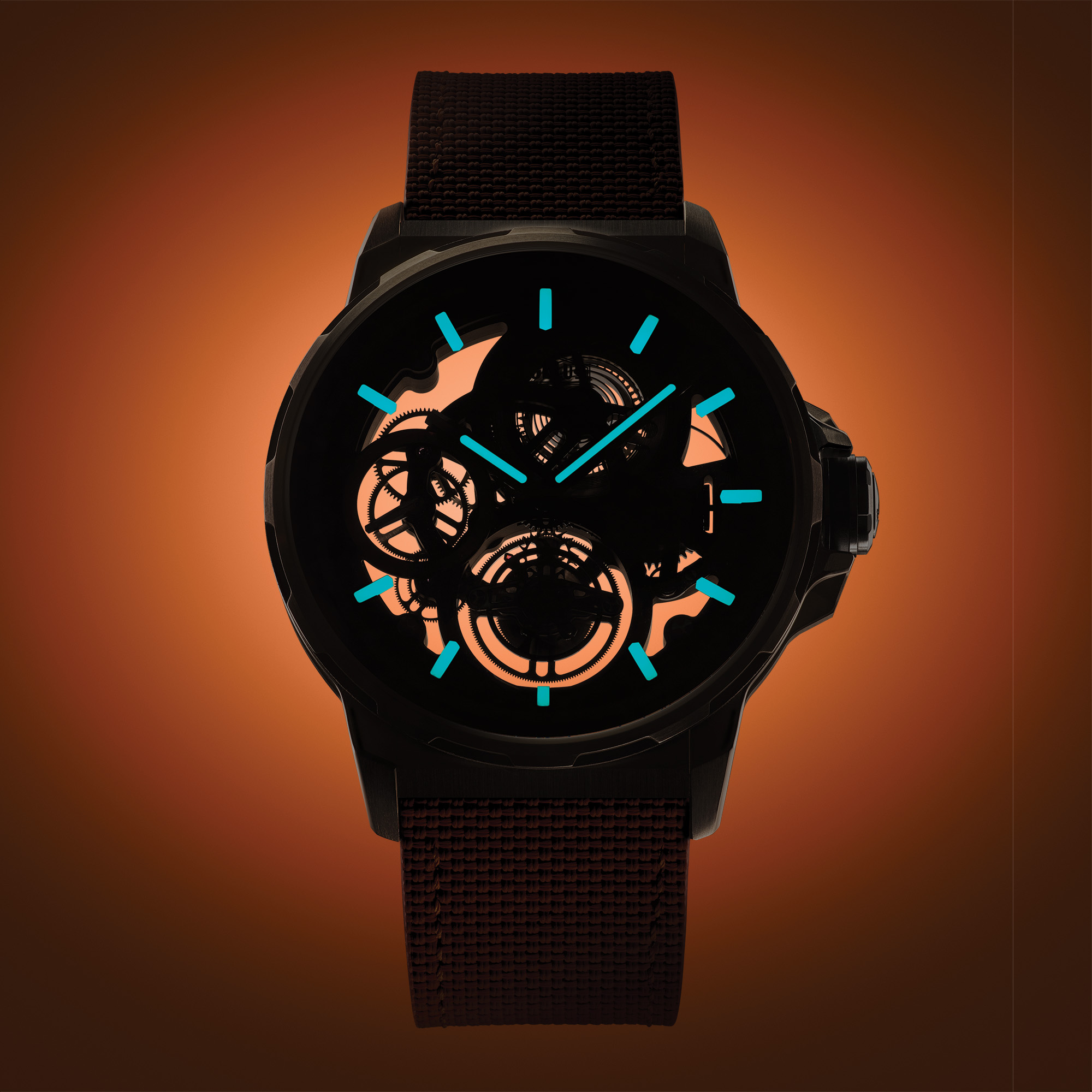
The dial features a floating orange minute track above a black flange, with hour markers crafted for the first time by Angelus in monolithic blocks of Super-LumiNova. These luminous elements ensure legibility in low light and reinforce the watch’s modern aesthetic. At the heart of the case lies a carbon composite chamber, lightweight yet rigid, surrounded by a modular titanium cage that enhances stability and mechanical appeal.

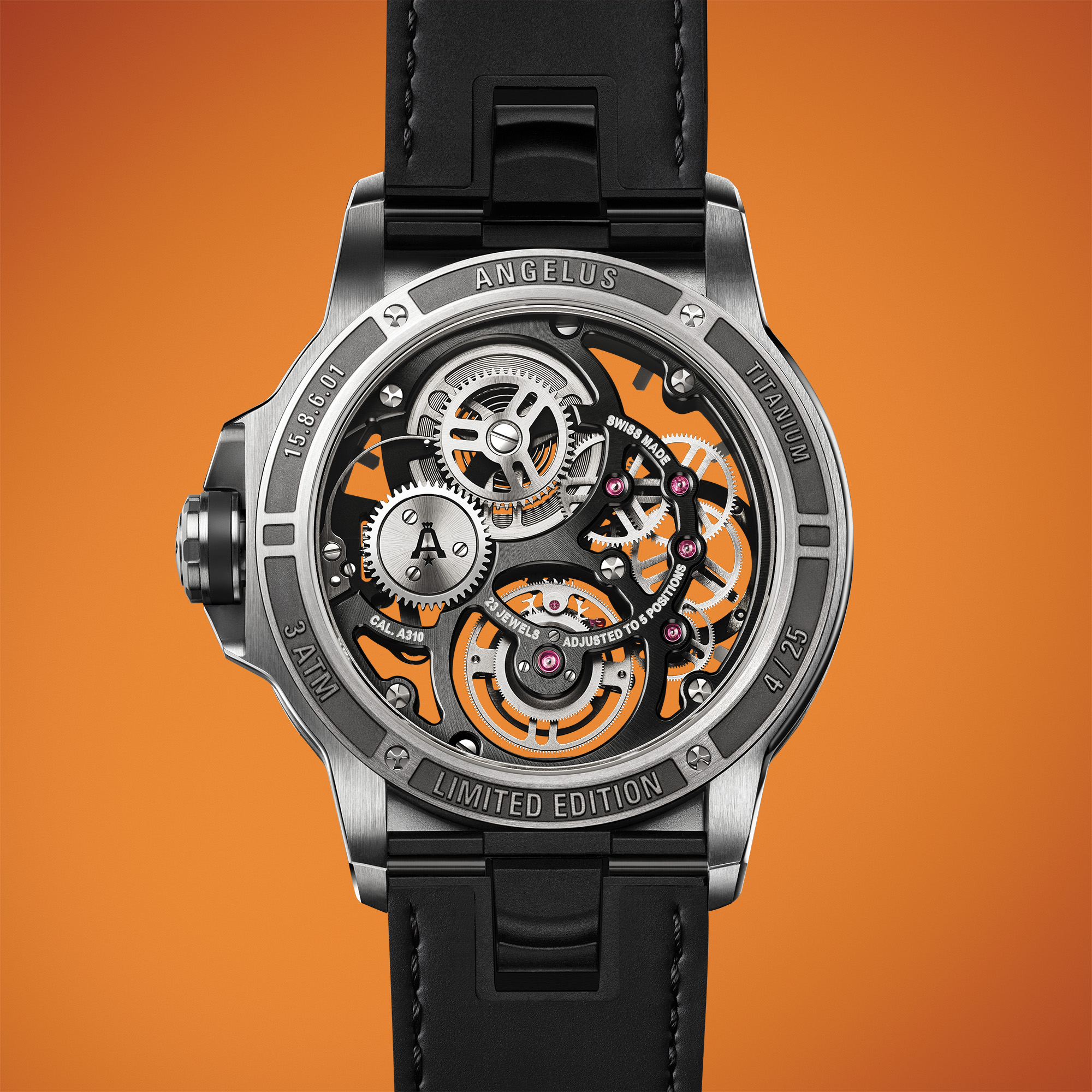
The A-310 calibre showcases Angelus’s signature three-spoke wheels, leading the eye to the flying tourbillon suspended without an upper bridge. Supported by a 160° angled bridge, this asymmetrical design intensifies visual tension and balance. The tourbillon completes a rotation every minute, oscillates at 4 Hz, and offers a 60-hour power reserve. The Flying Tourbillon Skeleton Titanium, Orange Edition embodies the Angelus L.A.B. philosophy—Legacy and Beyond—where technical mastery meets bold design to elevate mechanics into contemporary art.
 
View Watch Gallery
Image 1 Image 2Image 2

Flying Tourbillon Titanium Orange

Angelus Flying Tourbillon Skeleton Titanium, Orange Edition

Technical Specifications

Functions Hours, minutes, small seconds
Movement Calibre: A-310, mechanical manual winding, 1-minute flying tourbillon
Power reserve: 60 hours
Frequency: 4 Hz / 28,800 vph
Finishes:
- Main plate: sunburst, chamfered, polished, black PVD-treated
- Bridges: sunburst, chamfered, polished, black PVD-treated
- Wheels: rimmed
- Tourbillon cage: rimmed and rhodium-plated
- Tourbillon bridge: polished (blocked) and chamfered
Case Material:
- Case chamber: carbon composite
- Bezel, crown, and monobloc case: titanium, satin-finished surfaces, polished chamfers
Diameter: 32.80 mm
Height: 4.30 mm
Crystal sapphire with double-sided anti-reflective coating
Water Resistance 3 bar (30 metres / 100 feet)
Dial - Orange PVD-treated hour and small seconds flanges
- Hour markers and hands filled with Super-LumiNova
Strap Interchangeable strap system
- Options: satin-finish titanium bracelet, black alligator leather strap, orange rubber strap
- Folding clasp: titanium
Engraving “To the revered memory of John Arnold and Abraham-Louis Breguet. Friends in their time, legendary watchmakers always.”
Limited Edition 25 pieces

Related Articles

NOVEMBER 12 2025    |    Novelties

Neo Digiteur: Chronoswiss Revives the Mechanical Digital Icon

Chronoswiss proudly unveils the Neo Digiteur, a bold reinvention of an icon that first challenged convention two decades ago. Originally introduced in 2005 by founder Gerd-Rüdiger Lang, the Digiteur was a mechanical digital timepiece—a watch without hands—that defied expectations and celebrated horological artistry. Today, the Neo Digiteur returns sharper, stronger, and more modern than ever, crafted in stainless steel and infused with the pioneering spirit of its predecessor.

The design is architectural and tailored, with a rectangular case measuring 48 by 30 millimeters. Its sculptural lines are accentuated by sandblasted and polished finishes, while a reimagined onion-style crown ensures both elegance and ergonomics. At its heart lies a rare complication: a jumping hour regulator without hands. Time is displayed through three apertures—the jumping hour at twelve o’clock, digital minutes at center, and running seconds at six o’clock—creating a mechanical digital regulator that feels futuristic yet deeply analog.

Powering this display is the hand-wound Chronoswiss Caliber C.85757, beating at 3 Hz and offering a 48-hour power reserve. Developed entirely in-house, the movement features artisanal details such as hand-guilloché bridges and a sapphire crystal caseback that pays tribute to historic Fleurier calibers. Two limited editions express distinct personalities: Neo Digiteur Granit with an anthracite dial and Neo Digiteur Sand with a warm 4N sandblasted finish. Each version is limited to just 99 pieces, making the Neo Digiteur not a reproduction, but a true reinvention—a collector’s piece and a statement of mechanical artistry.

View Watch Gallery  
Image 1  Image 2  Image 3  Image 4
View More
JUNE 05 2025    |    Novelties

Greubel Forsey Redefines Haute Horlogerie with the New GMT Balancier Convexe

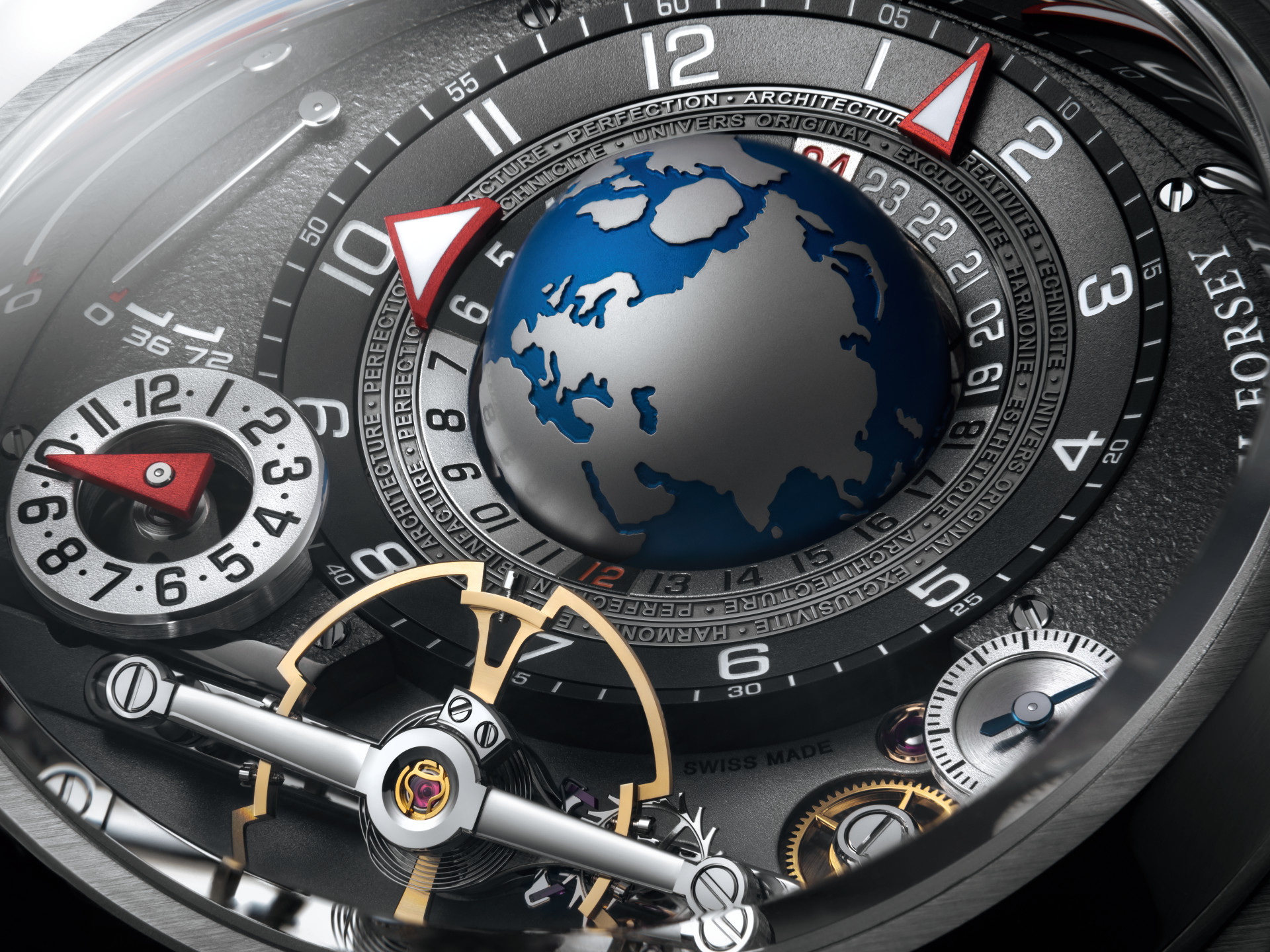
Greubel Forsey unveils its new GMT Balancier Convexe. As the Earth takes centre stage within a newly reimagined amphitheatre, the hours, minutes, seconds, second time zone, and universal time indications become both companions and spectators to its quiet revolution.

The new GMT Balancier Convexe replaces its predecessor entirely – not as a variation, but as a complete reinterpretation. With a redesigned case, an integrated power reserve, and enhanced ergonomics, it becomes the purest expression of our GMT complication to date – and the only GMT model in our current collection.

A refined evolution
– Titanium Convexe case now more compact at 42.90 mm for improved wearability.
– New 72-hour power reserve indicator seamlessly integrated into the dial.

Technical enhancements
– 496 components, 73 more than its predecessor.
– Inclined escapement suspended beneath polished steel bridge.
– Real-time rotating globe in layered amphitheatre.
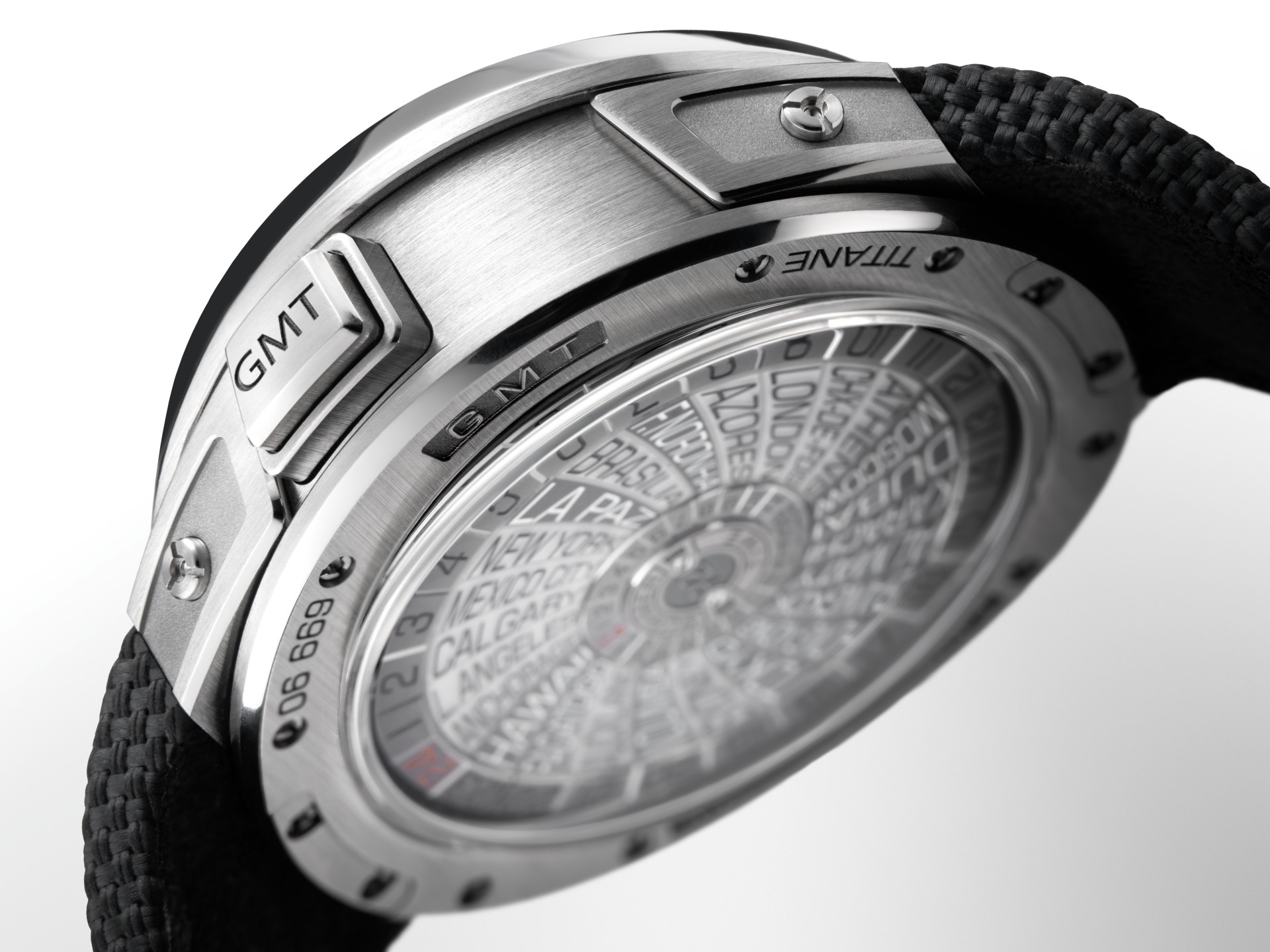
– Sapphire disc on caseback with 24 cities, La Chaux-de-Fonds replaces Paris.

Exclusivity
– Limited to 22 pieces worldwide.

View Watch Gallery
Image 1 Image 2
View More
MARCH 24 2025    |    Watches and Wonders 2025

Constant Force Tourbillon 11, yellow gold edition - A celebration of watchmaking ingenuity

The 41.5 mm diameter Constant Force Tourbillon 11 watch in 18-carat yellow gold, released by Arnold & Son as a limited edition of 11, is driven by a hand-wound mechanical movement. Equipped with two barrels to give a 100-hour power reserve, this timepiece was entirely developed and built at the manufacture in La Chaux-de-Fonds. It is fitted with a constant force mechanism visible on the enamel dial and is regulated by a tourbillon that can be seen on the back. The architecture of this calibre is inspired by that of the timekeeping instrument driven by the first tourbillon created by Abraham-Louis Breguet in 1808, based on a chronometer movement designed by John Arnold. This first tourbillon regulator, now in the British Museum, was given to John Roger Arnold by the Paris-based watchmaker in honour of his scientific collaboration and friendship with his father. The Constant Force Tourbillon 11 timepiece, designed to mark the end of the 260th anniversary celebrations of John Arnold’s legacy, pays tribute to the watchmaker’s ingenuity and his close association with Abraham-Louis Breguet.

The greatest watchmakers of the Age of Enlightenment often knew each other. Some of them exchanged views and appreciated each other despite language barriers and political obstacles. And this was the case with John Arnold and Abraham-Louis Breguet. These two watchmakers, undoubtedly the most productive of the second half of the 18th century, forged a friendship that nothing could shake, not even the throes of war between the two countries or the French Revolution. Aware of their respective talents, during Abraham-Louis Breguet’s frequent trips to London between 1789 and 1791, they shared their views and knowledge of the principles of timekeeping, furthering the science of timekeeping, which in their eyes definitely knew no frontiers.

View More
ENDLESS DISCOVERY IN YOUR INBOX
Join our mailing list to receive insider updates on our latest collections, invites to private events, and other personalized offerings.